
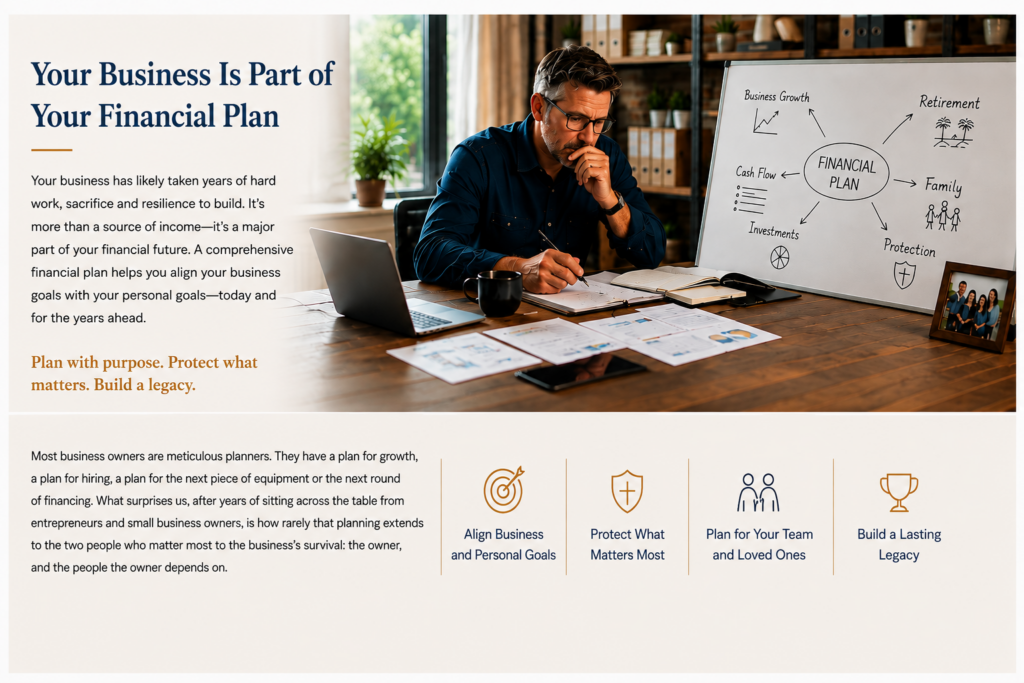
Your Business Is Part of Your Financial Plan
By David B. Stiglick, BA — Founder, TWMC – The Wealth Management Centre
Beacon Article of the Month
Protect the People. Protect the Business. Plan for the Future.
The Beacon Question™
If your business depends on you, what happens to the business—and everyone who depends on it—if life suddenly changes?
For many entrepreneurs, the business is much more than a place to work.
It may provide the family’s income. It may represent years or decades of accumulated wealth. It may employ children, relatives, long-time employees and people in the community. It may be intended to fund retirement, provide a legacy for the next generation, or eventually be sold to finance the next chapter of life.
And for many small and medium-sized business owners, there is another reality:
The owner and the business are deeply connected.
A serious illness affecting the owner can become a business problem. The death or disability of a partner can become an ownership problem. The departure of a key employee can become an operational problem. An unexpected tax liability can become a cash-flow problem. And the absence of a succession plan can turn years of successful business building into uncertainty at precisely the wrong time.
That is why a business owner’s financial plan should not stop at the front door of the business.
The business is part of the financial plan.
The Business May Depend on You More Than You Realize
Business owners spend enormous amounts of time protecting their companies.
They insure buildings, equipment and vehicles. They manage inventory. They maintain computer systems. They monitor expenses. They develop customers. They negotiate with suppliers. They hire employees and manage cash flow.
But one of the company’s most valuable assets may be much harder to see on a balance sheet:
the people whose knowledge, relationships, decisions and leadership keep the business operating.
In a small business, that person is frequently the owner.
Consider a simple question:
If you were unable to work for the next six or twelve months, what would happen?
Would your personal income continue?
Could your family maintain its lifestyle?
Could the company continue paying rent, salaries, utilities, loan payments and other fixed expenses?
Who would manage the company?
Would customers remain?
Would creditors remain patient?
Would someone have enough cash and authority to keep the business operating?
Disability insurance can help protect an individual’s income when illness or injury prevents that person from working. Business owners may also need to examine whether appropriate arrangements are available to help the business meet certain continuing expenses during an owner’s disability.
These are different risks.
Protecting the owner’s income and protecting the company’s ability to operate should therefore be considered together.
What If the Owner or a Key Person Becomes Seriously Ill?
Not every serious illness results in a permanent disability.
Cancer, heart attack, stroke and other significant medical events can create another type of financial disruption. An owner may survive and eventually return to work, but the months in between can create personal and business pressures.
This is where critical illness planning may become part of the conversation.
Depending upon the circumstances and the coverage selected, critical illness insurance can provide a lump-sum benefit following the diagnosis of a covered condition and satisfaction of the policy requirements.
But the planning question comes first:
If a serious illness occurred, where would the money come from?
Would the owner need funds personally?
Would the business need additional liquidity?
Would someone need to be hired temporarily?
Could debts still be serviced?
Would the owner want the financial flexibility to concentrate on recovery rather than immediately returning to work?
Insurance is only one possible funding tool.
The first step is identifying the financial exposure.
What Happens When There Is More Than One Owner?
Partnerships and closely held corporations introduce another layer of complexity.
Two people may build a successful company together for twenty years and still never fully answer a difficult question:
What happens if one of us dies, becomes disabled, retires, wants out—or can no longer participate in the business?
A properly prepared shareholder, partnership or buy-sell agreement can establish what is intended to happen.
But an agreement that requires one owner to purchase another owner’s interest also raises a second question:
Where will the money come from?
Life insurance is commonly considered as one possible way of funding obligations arising after an owner’s death. Disability-related buyout funding may also need to be considered.
The legal agreement and the financial arrangements supporting it should work together.
The exact structure can have significant legal and tax consequences, which is why the business owner’s lawyer, accountant and appropriate financial and insurance professionals should be involved.
The objective isn’t simply to own insurance.
It is to help ensure that an unexpected event does not leave surviving owners, the affected owner’s family, employees and the business itself trying to solve a major ownership problem during an already difficult time.
Who Else Does the Business Depend On?
Sometimes the most important person in a company isn’t an owner.
It may be the salesperson responsible for its largest accounts.
The technician with specialized knowledge.
The operations manager who understands every part of the company.
The professional whose credentials are essential to the operation.
Or the employee who has spent twenty years developing relationships that cannot easily be replaced.
That raises another Beacon question:
Which people would be hardest for this business to replace—and what would happen financially if one of them were suddenly gone?
Key-person insurance may form part of the answer.
But once again, insurance is not the starting point.
The starting point is understanding the risk: replacement costs, lost revenue, customer retention, recruiting and training expenses, debt obligations and the time required for the organization to recover.
Diagnose Before You Prescribe™.
Your Employees Are Part of the Plan Too
As a business grows, the financial planning conversation changes.
Attracting and retaining good employees becomes increasingly important.
Compensation is certainly part of that equation, but employees may also place considerable value on benefits such as health and dental coverage, life insurance, disability protection, retirement savings arrangements and other employee benefits.
The design of those programs deserves careful consideration.
Who should be eligible?
What should the employer pay?
What should employees pay?
How sustainable is the plan as the company grows?
What tax treatment applies?
How does the program compare with what competing employers provide?
Could an appropriately structured benefits or retirement program help the company attract and retain the people it needs?
Employer-paid premiums and contributions can have different tax consequences depending upon the type of insurance or benefit involved, making professional tax advice and proper plan design important.
The goal isn’t simply to offer “benefits.”
It is to develop a compensation and employee-retention strategy that makes sense for the business and its people.
Building the Owner’s Retirement Outside—and Inside—the Business
Business owners sometimes make an understandable assumption:
“My business is my retirement plan.”
Perhaps it will be.
But what happens if the business cannot be sold for the expected price?
What if the intended successor doesn’t want it?
What if the industry changes?
What if the owner wants to retire during an economic downturn?
Or what if health forces the owner to leave earlier than expected?
A business may represent substantial wealth, but relying upon one asset for retirement can create concentration risk.
Depending upon the owner’s circumstances and business structure, planning may include personal savings, registered retirement accounts, corporate investments, pension or retirement arrangements, insurance strategies and eventually the proceeds from selling or transferring the business.
The important issue is diversification of the retirement plan itself.
The owner should ideally have choices.
Retirement is easier to plan when leaving the business becomes an option rather than a financial necessity.
Eventually, Every Owner Leaves the Business
This may be the most important business-planning reality of all.
Every owner eventually exits.
The question is whether that transition happens by design or by circumstance.
An owner might:
- sell to an outside buyer,
- sell to employees or management,
- transfer the business to children or other family members,
- sell an interest to an existing partner,
- gradually reduce involvement,
- wind the business down, or
- leave unexpectedly because of illness, disability or death.
These possibilities have very different financial, tax, legal and family consequences.
And succession planning is becoming increasingly important in Canada. Federal government information published in 2026 notes that more than 17% of Canadian SME owners expect to exit their businesses within five years.
Yet succession planning shouldn’t begin six months before retirement.
Value needs time to be built.
Successors need time to be developed.
Tax strategies may require advance planning.
Legal agreements may need to be updated.
Insurance arrangements may need to be established while owners and other key people remain insurable.
And perhaps most importantly, the owner needs time to answer a surprisingly difficult question:
What does life look like after the business?
Tax Planning Is Business Planning
Taxes touch virtually every major business transition.
How an owner compensates themselves, retains or distributes corporate earnings, structures ownership, finances retirement, sells shares or assets, transfers a company to family members, funds a buy-sell agreement or ultimately transfers wealth to the next generation can produce different tax consequences.
Even the legal structure of the business matters.
A sole proprietorship, partnership and corporation do not operate identically when ownership changes, an owner retires, or an owner dies. CRA guidance specifically notes that the consequences following the retirement or death of an owner depend upon the business structure and, in a partnership, can depend upon the partnership agreement.
Tax planning should therefore not be something considered only at tax-filing time.
The accountant has an important role.
So does the lawyer.
And so do the professionals helping the owner with insurance, investments, retirement, succession and estate planning.
Good planning brings those conversations together.
The Business Plan and the Family Plan Eventually Meet
There is another side to business planning that is sometimes overlooked.
The family.
Imagine a successful owner with two children.
One has worked in the company for fifteen years and hopes to take it over.
The other chose a completely different career and has no interest in the business.
If most of the parents’ wealth is represented by the company, how should the estate eventually be divided?
Equal and fair may not necessarily mean the same thing.
Could the business pass to the child who has helped build it while other assets are left to the other child?
Could life insurance provide liquidity or help with estate equalization?
What tax liability could arise?
Will the company have enough cash?
Could family members be forced to sell something simply to meet tax or estate obligations?
These aren’t simply estate-planning questions.
They are family, business, tax and succession questions at the same time.
That is precisely why integrated planning matters.
A Business Owner Has More Than One Financial Life
A business owner may simultaneously be:
an entrepreneur,
an employer,
a partner or shareholder,
a spouse,
a parent,
an investor,
a future retiree,
and eventually, someone transferring a lifetime of accumulated wealth to another generation.
Those roles cannot always be planned independently.
A decision that is good for the corporation may have implications for the family.
A decision that reduces taxes today may affect retirement tomorrow.
A succession decision may affect children differently.
An insurance decision may affect a shareholder agreement.
An employee-benefit decision may affect the company’s ability to recruit.
And an estate-planning decision may determine whether the business survives into another generation.
This is why the most useful question may not be:
“What financial product does my business need?”
A better question is:
“What am I trying to protect, what could prevent the plan from succeeding, and what needs to be in place before that happens?”
Protect the People. Protect the Business. Plan for the Future.
A business can be one of the greatest financial accomplishments of an owner’s life.
But it is rarely just an asset on a balance sheet.
It may represent a family’s income.
An owner’s retirement.
A partner’s financial security.
Employees’ livelihoods.
Customers who depend on the company.
A future opportunity for children.
And decades of work that someone hopes will continue long after they leave.
That is why business planning shouldn’t begin with insurance, investments, pensions or tax strategies.
It should begin with a conversation.
What have you built?
Who depends on it?
What could put it at risk?
Where do you want it to take you?
And what happens when life changes the plan?
Once those questions are understood, the appropriate professionals can work together to determine what legal structures, financial strategies, insurance protection, employee programs, tax planning and succession arrangements may be appropriate.
At TWMC, we believe better financial decisions begin with understanding the whole picture.
Because your business isn’t separate from your financial plan.
Your business is part of your financial plan.
A TWMC Reflection
Products don’t solve problems. Proper planning solves problems. Products simply implement the plan.
For business owners, that principle may be particularly important.
The objective isn’t to accumulate policies, accounts and programs.
The objective is to build a financial plan capable of protecting the people, the business and the future you have worked so hard to create.
Diagnose Before You Prescribe™.
Educational Disclaimer
This article is provided for general educational and informational purposes only and is not intended to provide individualized financial, investment, insurance, tax, legal or accounting advice. Business structures, insurance needs, taxation, succession strategies and employee-benefit arrangements can vary significantly according to individual circumstances. Business owners should consult appropriately qualified legal, tax, accounting, insurance and financial professionals before implementing a strategy.
Last reviewed: August 16, 2026
Errors and Omissions Excepted (E&OE)
TWMC – The Wealth Management Centre
Financial Education and Planning Through Life’s Transitions
Helping Canadians make better financial decisions through education, planning, and ongoing guidance.
Educational Information Only
This article is provided for general educational and informational purposes only and is not intended to provide financial, investment, insurance, tax, legal, accounting, or other professional advice. Individual circumstances vary. Before making financial or business decisions, consider obtaining advice from appropriately qualified professionals based on your specific circumstances.
Last Reviewed: August 29, 2026
Published by: TWMC – The Wealth Management Centre