
Your Business Insurance Toolkit
Beacon Knowledge Centre by TWMC
By David B. Stiglick, BA — Founder, TWMC – The Wealth Management Centre
The Beacon Question™
If something happened to you tomorrow—an illness, an injury, or worse—could your business continue without you? And could your family?
Business owners are often meticulous about protecting the things their business owns: the building, equipment, vehicles and liability risks. But the people who make the business work—the owner, partners and key employees—can represent some of its greatest vulnerabilities.
That’s the gap this article explores: how protecting the people, the business and the owner’s financial future can become part of one coordinated plan.
What Happens If You or a Partner Can No Longer Run the Business?
Two people can build a company together for twenty years without fully answering a difficult question: what happens if one dies, becomes disabled, or simply wants out?
A properly structured buy-sell agreement can establish in advance what happens to an owner’s share of the business. When appropriate insurance funding is part of that arrangement, it can also help ensure that money is available when the agreement needs to be carried out.
Without that planning, surviving owners may find themselves negotiating the value and ownership of the business with a grieving family at exactly the wrong time. The legal agreement and its funding need to work together — typically involving coordinated advice from legal, accounting and insurance professionals.
Who Would Be Hardest for This Business to Replace?
Sometimes the person a business depends on most isn’t an owner at all. It may be the salesperson who holds the largest accounts, the technician with specialized knowledge, or the employee who understands how every part of the operation fits together.
If that person were suddenly gone, what would it cost the business in lost revenue, recruiting, training and disruption?
Key person insurance can help provide the business with funds to manage that financial impact while it recruits, reorganizes or recovers. The important question isn’t simply who works for the business — it’s who would be hardest for the business to replace?
Could the Business Keep Its Doors Open Without You?
Disability can create two very different financial problems for a business owner: replacing personal income and keeping the business operating.
Personal disability insurance can help replace income when an owner is unable to work. The details of the coverage matter, including how the policy defines disability and the circumstances under which benefits are payable.
The business faces a different problem. Rent, payroll, utilities and other expenses may continue even when the owner cannot work. Business overhead expense insurance can help cover eligible operating expenses while the owner recovers or the business has time to make other arrangements.
Protecting the owner’s income and protecting the business’s ability to operate are different risks. A sound plan considers both.
Diagnose Before You Prescribe™.
Where Does the Tax Bill Show Up?
Tax considerations touch many of the decisions a business owner makes — how income is received, how corporate earnings are retained or distributed, and how the business may eventually be sold or transferred.
Business structure matters too. A sole proprietorship, partnership and corporation can have very different tax consequences when an owner retires, sells or dies.
That’s why tax planning shouldn’t happen in isolation or only at filing time. Decisions involving tax, insurance, succession and retirement can affect one another, making coordinated advice from appropriately qualified professionals an important part of the planning process.
Who Takes Over When You’re Ready to Leave?
Every owner eventually leaves the business. The important question is whether that transition happens by design or by circumstance.
The business might be sold to an outside buyer, transferred to family, sold to a partner or management team, or left unexpectedly because of illness, disability or death. Each path can have different financial, tax and family consequences — and preparing properly can take years.
Good succession planning starts before it’s urgent. Building business value, identifying and preparing a successor, and coordinating the financial, tax and legal pieces all take time. If you had to leave the business tomorrow, how much of that plan would already be in place?
Are Your Benefits Helping You Keep Good People?
For many employees, compensation is about more than salary. Health and dental coverage, disability protection, life insurance and retirement benefits can all influence how people view the value of working for a business.
For the employer, the challenge is finding the right balance between meaningful benefits, affordability and the needs of the people the business wants to attract and retain.
A benefits program should therefore be reviewed as part of the broader business plan — not simply as an expense, but as one of the tools available to support and retain a strong team.
Is Your Retirement Tied Up in the Business?
For many business owners, the business represents a significant part of their retirement plan. That can create risk if too much of their future financial security depends on one asset and one eventual outcome.
What happens if the business sells for less than expected, the sale takes longer than planned, or the owner needs to step away sooner than anticipated?
Building personal savings and investments outside the business can provide greater flexibility and reduce dependence on a future sale. Retirement planning for a business owner should therefore consider both sides of the picture: the value being built inside the business and the financial resources being built outside it.
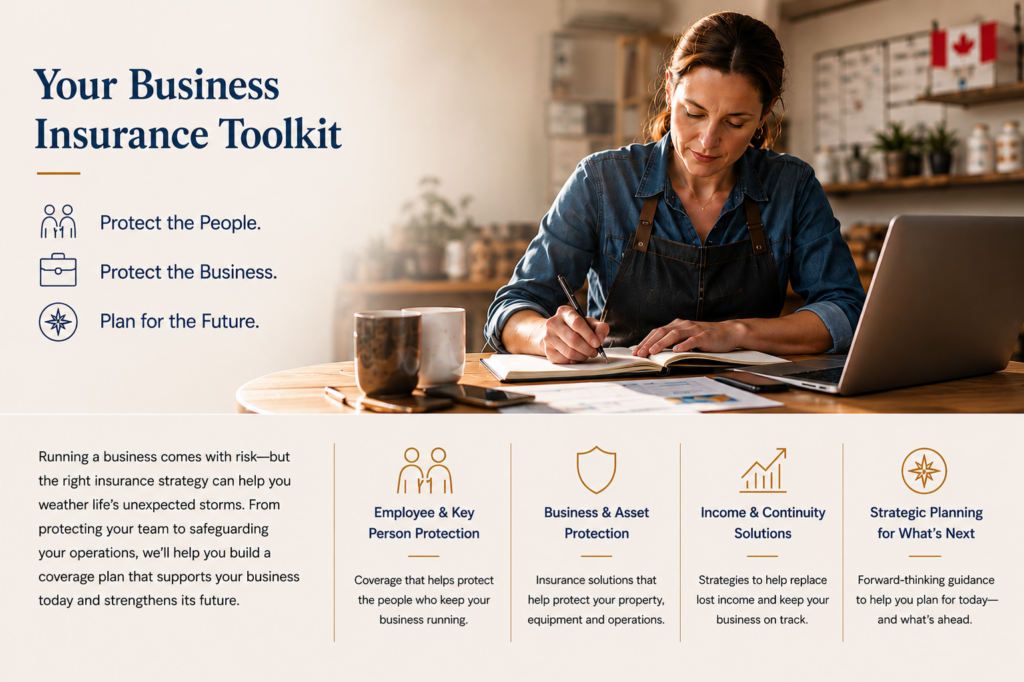
Protect the People. Protect the Business. Plan for the Future.
Business planning rarely comes down to one decision. Protection, succession, employee benefits, tax considerations and retirement planning can all affect one another.
The goal isn’t to solve everything at once. It’s to identify the most important gaps, establish priorities, and build a coordinated plan that can evolve as the business and the owner’s life change.
A TWMC Reflection
Products don’t solve problems. Proper planning solves problems. Products simply implement the plan.
For business owners, that principle carries extra weight. The objective isn’t to accumulate policies, accounts, and programs. It’s to build a plan capable of protecting the people, the business, and the future you’ve worked to create — and to keep revisiting that plan as the business and your life continue to change.
Diagnose Before You Prescribe™.
Have a Question About Your Business?
If this article raised a question about your business, your family, or the future you’re building, we invite you to begin a conversation when you’re ready.
Educational Information
This article is provided for general educational and informational purposes only and should not be considered individualized financial, investment, insurance, tax, legal or accounting advice. Individual circumstances vary. Where appropriate, readers should consult qualified professionals regarding their specific circumstances.
Last reviewed: September 3, 2026
E&OE
TWMC – The Wealth Management Centre
Financial Education and Planning Through Life’s Transitions
Helping Canadians make better financial decisions through education, planning, and ongoing guidance.